School of Veterinary Medicine
School of Veterinary Medicine Personal Information of the Dean
Name: Dr. Milkessa Tessema (DVM, MVSc)
Position: Dean
Specialization: MVSc in Veterinary Public Health
Academic Rank: Assistant Professor
Mobile: +251912257297
E-mail: mengistut38@gmail.com/milkitessema@gmail.com
MESSAGE OF THE DEAN
As dean School of Veterinary Medicine I am delighted to welcome future students and other website visitors including researchers, guests, alumni, and community members. The choice to become a veterinarian is a thrilling opportunity. Becoming a veterinarian is more than a career choice, it‟s a calling. A call to contribute to the well-being, healing, new discoveries, and enhancement of both animals and the people closely connected to them
Core Value
Program core values are: Students focused, commitment, strive for quality, teamwork, compassion, lifelong learning, community centered, innovation, committed to professional
ethics, respect for diversity, and work for animal welfare.
Our Mission
Mission: The mission of the DVM program is to provide quality educational experiences and
produce competent graduate with best practices in veterinary medical education, problem solving
graduates and advancing the health of animals, people, and the environment in Ethiopia.
Our Visions
The vision of the school is to be one of the top ten leading schools in veterinary teaching and problem-solving research in East Africa by 2040.
ABOUT THE SCHOOL
School of Veterinary Medicine was launched at Borana University since 2014 E.C. The School was recognized and started its work actively in the same year with DVM programme in Yaballo Town at Borana University Main campus which is located 570 Km south to the Capital city Addis Ababa. Academic quality, community services and research-based pursuit are the three vital wings of academic institution. Taking these three pillars into account the school, has been serving the students in delivering quality education (Preparing the students with the knowledge, skills, and ethical understanding to practice veterinary medical education.), conducting problem-solving research and providing community services.
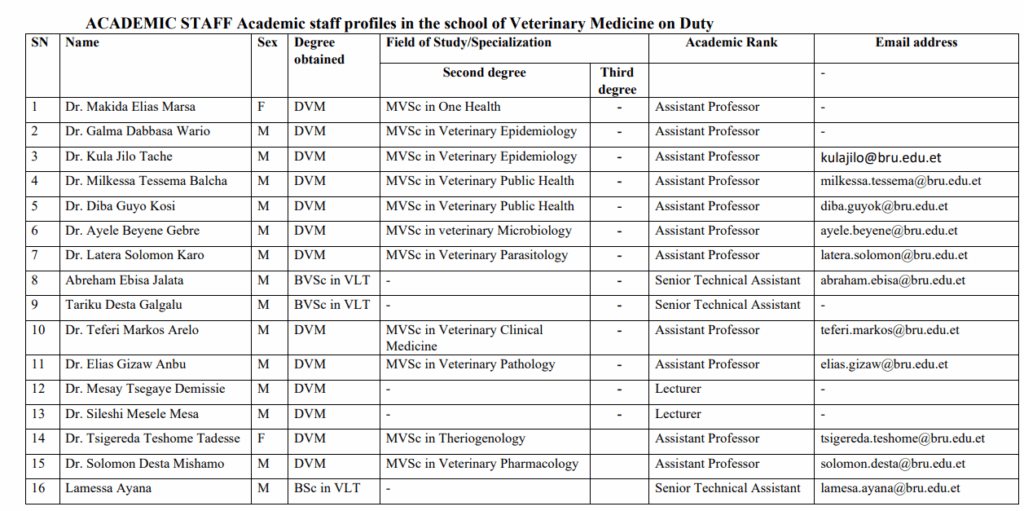
The numbers of current academic staffs of School are 16 where 14 are males and the remaining 2 are females. Among the total 11 instructors are holders of Masters Degree, 2 holders of DVM degree and 3 holders of BVSc in Veterinary Laboratory Technology. The School has also planned to launch other programs in regular BVSc, extension and winter (off season) programs in near future.
Overview of the Program
The Doctor of Veterinary Medicine (DVM) program is an undergraduate program emphasis on animal health and the study of diseases that affect all animal species. Veterinarians receive comprehensive training in all basic and clinical sciences with relation to a variety of species, including food-producing animals, equines, companion animals, birds and wildlife. The aim of the program is to produce competent and compassionate veterinarians that are capable of taking on and managing activities of any sort in animal health, ensure health and welfare of animals and protect human health
Entry and Admission Requirements
Natural science students who pass the Ethiopian Higher Education Entrance Certificate Examination and without major disabilities, which would hinder the individual„s ability to deliver his/her professional services, and assigned by the Ministry of Science and Higher Education (MoSHE) are accepted. As per the new MoSHE guideline considering the current curriculum revision student department selection method will be based on the following approaches: an orientation regarding available departments found in the institution and their relevance need to be given and awareness can be created by brochure and leaflets. Students will be subjected to rank all the departments according to their priority interest. Then, Selection can be made by using the ESLCE (40%), first semester result (30%) and Entrance exam related their attitude (30%).
Advance standing (diploma holders)
Candidates with the background of Animal health, Animal production, and related Natural Science fields that have CGPA of 2.5 and above, two years‟ work experience and who passed Certification of Competency (CoC) and entrance examination
Course breakdown
Phase I: Preclinical year (Year I and II)
This phase focuses on the normal (healthy) structure and functions of an organ and organism in general of different animals (including birds). Towards the end, this phase focuses on factors that affect the normal body functions, which allows the student to compare abnormalities against the base line normal.
Phase II: Clinical Years (Year III-V)
This phase focuses on clinical experiences to equip students with the skills of diagnosis, treatment, prevention and cure of animal diseases.
Phase III: Externship (Year VI)
This phase is essential and indispensable course element to integrate the knowledge and skills of a student mainly at the field experiences including clinical, laboratory, abattoir and farm practices and research work implementations.
Graduation Requirements and Degree
A student must take the minimum total credit hours (218) , score cGPA of greater than or equal to 2.00 and shall not have “F” grade in any subject and less than “C” grade in selected major courses. The Degree awarded for graduates that fulfill the necessary requirements is In English “Doctor of Veterinary Medicine” (DVM) In Amharic “በእንሰሳት ሕክምና የዶክተርነት ዲግሪ”
RESEARCH APPROACH
Applied Research: Conducting studies that provide practical solutions to livestock health challenges in the Borana range lands in particular and in the country in general.
THEMATIC AREAS AND RESEARCH PRIORITIES
In order to improve major problems of animal health, veterinary public heath, and animal production the School of Veterinary Medicine has chosen and organized seven research thematic areas consisting of twenty-two research groups.
- Animal Health and Disease Control
Antimicrobial and antiparasitic resistance (AMR) Surveillance:
✓ Monitoring and reducing the use of antibiotics and antiparasitic in food animals.
✓ Developing alternatives to antibiotics and antiparasitic, such as phage therapy and
probiotics.
✓ Understanding AMR transmission between animals, humans,
and the environment.
Epidemiological studies on major livestock diseases and infectious diseases: Conducting comprehensive studies to understand the distribution and determinants of prevalent livestock diseases. Developing and implementing strategies to diagnose and control diseases that are both persistent and newly emerging.Ethnos veterinary practices and traditional animal health remedies: Exploring and documenting indigenous knowledge and practices related to animal health.
- Veterinary Public Health, Food Safety and One Health
- Foodborne zoonotic diseases and their public health impact: Assessing the prevalence and impact of diseases transmissible from animals to humans through food.
- Animal origin food safety and drug residue monitoring: Evaluating hygiene practices and safety standards in meat, milk, and honey and fish meat production and processing. Implementing systems to detect and control residues of veterinary drugs in food products.
Public awareness and knowledge, attitudes, and practices (KAP) Studies on zoonotic
disease prevention: Conducting studies to understand and improve public awareness and
practices regarding zoonotic diseases.
- Integrated studies on zoonoses at the human-animal-environment interface: Conducting research that considers the interconnectedness of human, animal, and
environmental health.
- Livestock production, management and socio-economic matters
- Genetic improvement and breeding programs for indigenous breeds: Enhancing the genetic quality of local livestock breeds to improve productivity and resilience.
- Reproductive performance and artificial insemination studies: Investigating reproductive traits and the application of artificial insemination to improve breeding
outcomes.
- Poultry and Apiculture Research
Honey bee disease diagnostics and sustainable apiculture development: Advancing diagnostic methods for bee diseases and promoting sustainable beekeeping practices
Prevalence of poultry diseases: Studying the prevalence of diseases in poultry. Management practices for small-scale poultry farms: Developing and promoting best
practices for managing small-scale poultry operations.
Wildlife and Conservation Medicine
Collaborative Conservation Medicine Initiatives: Fostering partnerships for integrated approaches to wildlife health and conservation.
Disease surveillance at the human-wildlife-livestock interface: Monitoring and controlling diseases that can be transmitted between humans, wildlife, and livestock.
Health status monitoring of wildlife in protected areas: Assessing the health of wildlife populations within conservation areas.
Ecological studies on wildlife disease vectors: Investigating the role of environmental factors in the spread of wildlife diseases.
- Animal Welfare and Ethics
- Assessment of welfare conditions in domestic and working animals: Evaluating the living conditions and treatment of animals in various settings.
- Animal transportation and slaughter practices: Studying the impacts of transportation and slaughter methods on animal welfare.
- Educational outreach on animal rights and welfare: Promoting awareness and education on ethical treatment of animals.
- Veterinary Education and Capacity Building
- Research on curriculum relevance and graduate competencies: Assessing and enhancing veterinary education curricula to ensure graduates are well-prepared.
- Use of technology and digital learning in veterinary training: Integrating digital tools and platforms into veterinary education.
- Impact evaluation of clinical outreach and externships: Evaluating the effectiveness of practical training experiences in veterinary education
Community Services
- Improve Animal Health Services in Rural Areas
- Deploy mobile veterinary clinics: Providing veterinary services to remote areas through mobile clinics.
- Conduct monthly outreach and emergency response: Organizing regular outreach programs and emergency responses to address urgent animal health issues.
- Raise Public Awareness on zoonotic and public health issues
- Conduct community-based training: Offering training programs to communities on health and safety practices.
- Provide workshops on disease prevention, hygiene, and food safety: Conducting workshops to educate the public on preventing diseases and ensuring food safety
- Strengthen Local Veterinary Capacity
- Empowering community animal health workers: Providing training to local individuals to become community animal health workers.
- Run short courses and certification programs: Offering short-term courses and certification programs to enhance veterinary skills.
- Promote Participatory Research
- Engage communities in co-design: Involving communities in the design of research projects.
- Include local input in project design and data collection: Ensuring local perspectives are incorporated in research design and data collection.
Research Dissemination Methods
Disseminating research refers to the process of sharing and spreading the insights, findings, methodologies, theories, and analyses resulting from studies to a wider audience through various publication outlets. There are many options for researchers to get their findings out to the world. The type of desired dissemination plays a big role in choosing the medium and the tone to take when sharing the information. The following are some of the research dissemination methods we will use as school.
✓ Academic dissemination: Sharing research findings in academic journals, which typically involve a peer-review process.
✓ Policy-oriented dissemination: Creating documents that summarize research findings in a way that is understandable to policymakers.
✓ Public dissemination: Using television and other media outlets to communicate research findings to the public.
✓ Educational dissemination: Developing curricula for education settings that incorporate research findings.
✓ Digital and online dissemination: Using digital platforms to present research findings to
a global audience.